Friday, July 19, 2019

Xiaomi Mi A3 vs Xiaomi Mi 9 SE

Xiaomi has just unveiled its latest Android One smartphone, the Mi A3. Apart from the stock Android UI, the Mi A3 also has 4GB of RAM, Snapdragon 665, and triple rear cameras. We put it up against another of Xiaomi’s smartphones recently launched this year, the Mi 9 SE. Check it out!


Xiaomi Mi A3
Xiaomi Mi 9 SE
6.088-inch HD+ (1560 x 720) Super 
AMOLED Dot Drop display, 286ppi
5.97-inch FHD+ (2340 x 1080) 
Super AMOLED Dot Drop display, 432ppi
Corning Gorilla Glass 5
Qualcomm Snapdragon 665
Qualcomm Snapdragon 712
Adreno 610 GPU
Adreno 616 GPU
4GB RAM
6GB RAM
64GB/128GB storage
64GB/128GB storage
Expandable up to 256GB via microSD
Non-expandable
48MP F1.79 main + 8MP F2.2 ultrawide + 
2MP F.24 depth triple rear cameras
48MP F1.8 + 13MP F2.4 ultrawide +8MP F2.4 telephoto triple rear cameras
32MP F2.0 front camera
20MP F2.0 front camera
Dual SIM
Dual SIM
4G LTE
4G LTE
Wi-Fi
Wi-Fi
Bluetooth 5.0
Bluetooth 5.0
GPS, A-GPS, GLONASS, BDS
GPS, A-GPS, GLONASS, Beidou, Galileo
IR Blaster
IR Blaster
No NFC support
NFC
3.5mm audio jack
No 3.5mm audio jack
Under display fingerprint scanner, face unlock
In-display fingerprint scanner, face unlock
USB 2.0 Type C
USB 2.0 Type-C
Android One (Android 9 Pie)
MIUI 10 (Android 9 Pie)
4,030mAh battery with 18W Quick Charge 3.0
3,070mAh battery with 18W Fast Charge
153.5 x 71.9 x 8.5 mm
147.5 x 70.5 x 7.5 mm
173.8 g
155 g
Xiaomi Mi A3
  • Larger screen
  • Expandable storage up to 256GB via micro SD
  • 32MP front camera
  • 3.5mm audio jack
  • Larger battery capacity
  • Stock Android
Xiaomi Mi 9 SE
  • Faster CPU performance
  • Larger RAM capacity
  • NFC support

Beginning with the display, the Mi A3 comes with a larger screen size at 6.088-inches, while the Mi 9 SE comes in a smaller size of 5.97-inches. While the 9 SE does have a smaller display, it has an FHD+ resolution, compared to the A3’s HD+ resolution. Both smartphones are Super AMOLED though, and both of them have Xiaomi’s Dot Drop display — which is pretty much just a fancy term to say that they have drop notches upfront. Both smartphones are also protected with Corning Gorilla Glass 5.

When it comes to processors, the Mi A3’s powered by Snapdragon 665, one of the latest mid-range chipsets launched by Qualcomm. An upgrade over the Snapdragon 660, the SD 665 has an 11nm architecture and comes equipped with Kryo 260 Cortex A-73 and Cortex-A-53 processors. We’ve yet to see the actual performance of the SD 665 on a device, however.

On the other hand, the Mi 9 SE is powered by Snapdragon 712, the successor to the Snapdragon 710. We’ve seen the SD 712 perform, and with its 10nm architecture and multiple cores, the SD 712 would be more powerful than the SD 665. The SD 712 is, after all, built mainly for gaming and AI.

The Mi A3 has 4GB RAM, while the Mi 9 SE easily trumps that with its 6GB RAM. Both smartphones have two storage variants, 64GB and 128GB. While some people may be satisfied with those storage options, the Mi A3 goes an extra mile with its expandable storage of up to 256GB via microSD. The Mi 9 SE doesn’t have any storage expansion options, which might be a disappointment for some.

As for cameras, the A3 possesses a 48MP + 8MP + 2MP triple rear camera setup. Meanwhile, the 9 SE has 48MP + 13MP + 8MP cameras, also located on the rear. On paper, the Mi 9 SE’s triple cameras trump what the A3 has. Still, both of them do have a 48MP main shooter and ultrawide lenses. Front camera-wise, the A3 has a 32MP shooter, while the 9 SE has a 20MP one. The specs do look good on paper but of course, we’ve yet to see how the A3’s cameras actually perform.

Users may virtually pay using the Mi 9 SE’s NFC support; unfortunately, the Mi A3 doesn’t have this feature. Something that can be found on the Mi A3 though is a 3.5mm audio jack, which the Mi 9 SE in turn, doesn’t have. Both smartphones have face unlock features and have in-display fingerprint scanning. The two devices also have USB Type-C as their charging ports.

Here are the prices of each smartphone and their variants:

Mi A3:
  • 4GB + 64GB – EUR 249 (~PHP 14,270)
  • 4GB + 128GB – EUR 279 (~PHP 15,989)
Mi 9 SE:
  • 6GB + 64GB: PHP 15,990
  • 6GB + 128GB: PHP 17,990
We’ve yet to know about the Xiaomi Mi A3’s local pricing and availability so, between the two devices, the Mi 9 SE is currently the more accessible one as it’s been available for purchase in the country since May. If you’d like a device with expandable storage and a stock Android experience, do go for the Mi A3. If you’d rather have a device with FHD+ resolution and a better CPU performance, go for the Mi 9 SE.

Source: Yugatech
Share:

Tuesday, February 26, 2019

Huawei Mate X our foldable future

Huawei’s version of a foldable phone is now official.


The Mate X, similar to the Galaxy Fold, turns into a more prominent 8-inch display once unfolded from its 6.6-inch and 6.32-inch estates. Unlike the latter, though, it’s capable of having expandable storage through its proprietary nano-memory (NM) cards. It also sports 5G capability with its Kirin 980 chip embedded with the company’s Balong 5000 5G modem. Similar to the Mate series, the phone also sports triple Leica cameras.


The company also touts to have a thinner folding hinge, thanks to its ‘falcon wing’ mechanism that is said to bring a better back-to-back fold without any gaps. This enables the company to tout the device thickness of 11 millimeters, even when folded. Its battery is also not to be shadowed, as the company promotes faster charging that delivers from 0% to 85% in just 30 minutes.


Huawei Mate X key specs:
  • 8-inch 8:7.1 AMOLED screen @ 2480 x 2200 px (unfolded)
  • 6.6-inch 19.5:9 display @ 2480 x 1148 px (front, when folded)
  • 6.4-inch 25:9 display @ 2480 x 892 px (back, when folded)
  • Octa-core HiSilicon Kirin 980 5G chip
    2x Cortex A76 2.6GHz + 2x Cortex A76 1.92GHz + 4x Cortex A55 1.8GHz
    Balong 5000 5G modem
  • 8GB RAM
  • 512GB storage
  • expandable via Huawei NM up to 256GB (uses SIM2)
  • 40MP (Wide Angle Lens, f/1.8) + 20MP (Ultra Wide Angle Lens, f/2.2) + 8MP (Telephoto, f/2.4) Leica Triple cameras, AI Stabilization
  • Dual SIM (hybrid, nano), Dual Standby
  • Wi-Fi 802.11 a/b/g/n/ac
  • Bluetooth 5.0
  • Dual-band GPS, A-GPS, GLONASS, BDS
  • Fingerprint sensor
  • USB 3.1 Type-C
  • EMUI 10 (Android 9 Pie)
  • 4,500mAh Li-Po battery
    55W Fast Charge
    Huawei Supercharge
Huawei will launch the Mate X this mid-year in key countries with a EUR 2,299 price tag, or roughly Php135,700 when directly converted.

Share:

Friday, December 13, 2013

Twitter introduces changes to block functionality, reverses them immediately

Only hours after Twitter introduced changes to the functionality of its block feature, it was forced to reverse them amid widespread outrage from users who claimed the social networking was exposing victims of abuse to perpetrators.
According to Reuters, executives held a late-night meeting in Twitter's San Francisco office to discuss the reaction to the changes, before publishing a blog post in the early hours of Friday morning to announce that the block feature had reverted to its previous functionality.
"Earlier today, we made a change to the way the 'block' function of Twitter works. We have decided to revert the change after receiving feedback from many users -- we never want to introduce features at the cost of users feeling less safe. Any blocks you had previously instituted are still in effect," wrote Michael Sippey, vice president of product at the social network.
The changes to the block feature meant that accounts blocked by a user would still be able to follow the user and favourite and retweet their tweets. Now they have been reversed, blocked users will once again have no way to view a user's feed or interact with them when they are logged in. Logged-out users have always been to see the Twitter feeds of people who have blocked them, but being unable to follow their tweets in their feed and respond to them does offer victims of abuse some level of protection.
The reason Twitter implemented the changes in the first place was to prevent people being able to see when they had been blocked and then retaliating. Reversing the changes obviously means the problem of retaliation still exists, but Twitter has promised not to give up on finding a solution to prevent this kind of abuse.
"Some users worry just as much about post-blocking retaliation as they do about pre-blocking abuse. Moving forward, we will continue to explore features designed to protect users from abuse and prevent retaliation," writes Sippey.
Twitter has been implementing a series of small tweaks and adjustments recently in order to fine-tune the platform, but hopefully it's learnt a valuable lesson here -- that suddenly changing the level of control users have over their online safety with little warning leaves them feeling powerless and vulnerable.
Time and again, Twitter users have exhibited self-policing behaviour, but the social network still needs to be careful about how it handles the responsibility it has to protect victims from targeted abuse with its basic privacy infrastructure. It clearly does take this seriously, but Twitter's huge and diverse community ultimately has different needs and requirements, as well as differing views about how functionality should be implemented. However, shifting the emphasis of a safety feature from tackling one type of abuse to another -- which is one way the changes could be interpreted -- affects the trust of all users. It's something that Facebook had to figure out the hard way: there's no one size fits all solution to privacy, but adjusting exposure levels of users without warning is never going to be well received.
Kudos to Twitter, though, for reacting so swiftly to users' complaints. The task of tackling retaliation is unenviably tricksy, but at least the social network is acknowledging the nuanced and multifaceted nature of the abuse that does take place on the platform. Perhaps it's a conundrum that could be put to the mysterious #birdsignals community that the company recently launched.

Share:

Smart Nexus 5 Priced at P22,990 on Prepaid, Free on Plan 1500

Smart Communications previously announced that the Google Nexus 5, the pure Android handset made by LG, will be offered exclusively by the network.  Today, Smart officially launched the phone and also revealed the pricing details.
Nexus 5 Press Image 1 600x409 Smart Nexus 5 Priced at P22,990 on Prepaid, Free on Plan 1500
In the US, the Nexus 5 retails for $349.  Buyers are of course interested to know the prepaid price of the Nexus 5 in the Philippines.  Smart is offering the Nexus 5 for Php22,995 without contract.  Other retailers in the Philippines (online retailers mostly) are however selling the most basic variant of the Nexus 5 for only Php20,980.  That’s a difference of about P2,000.  If you want to get the Nexus 5 with a Smart plan, the network is offering the device for free on Unlidata Plan 1500.  This plan comes with 60 minutes of calls and 120 text messages free, but you will be locked in for 30 months.
The Nexus 5 runs Android 4.4 KitKat and packs a 4.95-inch full HD 1080p display, 2.2GHz quad-core Snapdragon 800 processor,  2GB of RAM, LTE connectivity, Bluetooth 4.0, 802.11ac WiFi, NFC, 8MP rear camera and 2,300 mAh battery.
Share:

Sony Launches 2-in-1 Flash Drives for Android Phones and Tablets

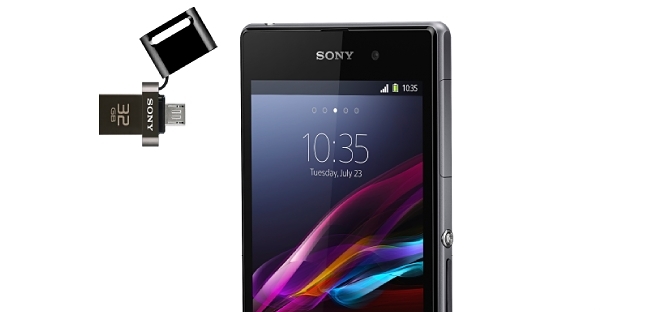
Sony recently launched new flash drives with 2-in-1 functionality.  The new Sony flash drives combine a full USB 2.0 port and a micro-USB connector, complete with OTG (on-the-go) connectivity for devices that run Android 4.0.3 and higher.
sony flash drive otg 610x288 Sony Launches 2 in 1 Flash Drives for Android Phones and Tablets
The new Sony flash drives are small and compact, with the micro-USB port hidden under a cap located on the other side of the device.  These flash drives are ideal for Android users who need that extra memory, or those who need to access and transfer files from laptops or desktops to their mobile devices.
sony flash drive otg 21 610x210 Sony Launches 2 in 1 Flash Drives for Android Phones and Tablets
Sony also offers a complimentary app to help users manage files. The app can be downloaded from the Google Play store.
The new Sony flash drives aren’t that expensive.  There are three different memory capacities, namely, 8, 16, and 32GB, priced at $19.99, $29.99, and $62.99, respectively.  In Philippine peso, that translates to about Php860, Php1,290 and Php2,700, respectively.
These new Sony flash drives will be available starting in January, 2014.
Share:

Social

Technology & Computers - Top Blogs Philippines

Subscribe via Email

Enter your email address:

Delivered by FeedBurner

FeedCount

dablogtech.com. Powered by Blogger.

Total Pageviews

Recent in Sports

Random Posts

Recent

Enter your email address:

Delivered by FeedBurner

Recent Posts

Unordered List